
In industries like dairy, food, beverages, and pharmaceuticals, the choice of fittings plays a critical role in maintaining hygiene, efficiency, and product safety. Among the many fitting types available, Tri-Clamp (TC) fittings are the most common in sanitary applications. But how do they compare with other pipe fittings such as buttweld, threaded, or socket-weld fittings?
Table of Contents
ToggleThis guide by Nutech Overseas, a leading manufacturer and exporter of stainless steel dairy and sanitary fittings, explains the key differences between TC fittings and other pipe fittings.
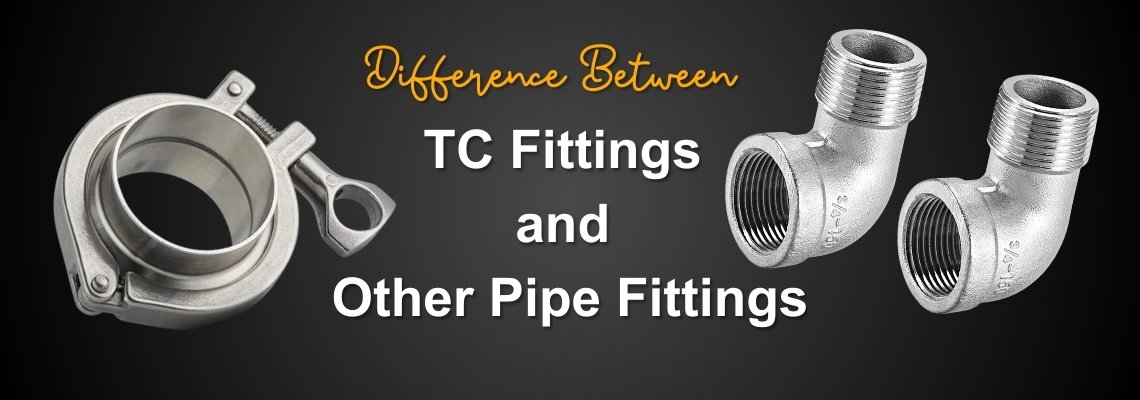
What Are TC (Tri-Clamp) Fittings?
Tri-Clamp (TC) fittings, also known as sanitary clamp fittings, are designed for quick assembly and disassembly without tools. They consist of:
- A ferrule end (welded or attached to a tube).
- A gasket for sealing.
- A clamp that locks the connection.
Used widely in dairy plants, breweries, food processing, and pharmaceuticals, TC fittings ensure hygiene, leak-proof sealing, and easy maintenance.
Types of Other Pipe Fittings
Apart from TC fittings, industries use a variety of fittings depending on pressure, fluid type, and application:
- Buttweld fittings (ASME B16.9): Welded permanently, strong and durable.
- Threaded fittings (ASME B16.11): Screwed connections, quick to assemble but less hygienic.
- Socket-weld fittings: Small bore fittings requiring welding, good for high-pressure applications.
- Flanges (ASME B16.5): Used for detachable piping connections.
TC Fittings vs Other Pipe Fittings – Key Differences
| Feature | TC (Tri-Clamp) Fittings | Other Pipe Fittings |
|---|---|---|
| Assembly & Disassembly | Quick, tool-free connection | Requires welding or threading |
| Hygiene | Designed for sanitary applications, smooth internal polish | Threaded/welded joints may trap contaminants |
| Strength | Moderate – best for low to medium pressure | High – suitable for high-pressure pipelines |
| Applications | Dairy, food, beverages, pharmaceuticals, biotech | Oil & gas, petrochemical, refinery, power plants |
| Maintenance | Easy to clean and replace | Difficult – may require cutting, welding, or re-threading |
When to Choose TC Fittings?
- If your industry demands hygiene and frequent cleaning (CIP/SIP systems).
- For low to medium pressure pipelines.
- Where quick maintenance is important.
- For industries like milk processing, breweries, juice, cosmetics, and pharma.
When to Choose Other Pipe Fittings?
- For high-pressure or high-temperature pipelines.
- In oil, gas, refinery, and power plants.
- When permanent, leak-proof strength is needed.
- For structural piping applications.
Why Nutech Overseas for Dairy & TC Fittings?
- Leading manufacturer & exporter of Stainless Steel TC Fittings, Dairy Bends, Unions, Ferrules, and Clamps.
- Manufactured in SS 304, SS 316, SS 316L, Duplex UNS S32205 / S32750, Inconel, Hastelloy, Monel, Titanium and more.
- Complies with 3A, SMS, DIN, BS4825, and ASME BPE standards.
- Exports to food, dairy, beverage, and pharmaceutical industries worldwide.
Final Thoughts
The choice between TC fittings and other pipe fittings depends on your industry, operating pressure, and hygiene requirements. While TC fittings are unmatched in food-grade and sanitary applications, other fittings like welded, threaded, and flanged remain essential for industrial and high-pressure systems.
At Nutech Overseas, we specialize in manufacturing high-quality stainless steel dairy and sanitary TC fittings for global industries, ensuring precision, hygiene, and compliance with international standards.
For inquiries, reach out to sales@nutechoverseas.com