
When it comes to the dairy, food, beverage, and pharmaceutical industries, hygiene and product safety are non-negotiable. That’s why Tri-Clamp (TC) fittings and sanitary fittings are manufactured from only the highest-grade stainless steel materials—primarily 304 and 316L.
Table of Contents
ToggleAt Nutech Overseas, one of the trusted manufacturers and exporters of stainless steel dairy fittings, we ensure our products meet 3A, ASME BPE, DIN, SMS, and ISO standards, making them suitable for global markets. But why are SS 304 and 316L the most preferred choices? Let’s break it down.
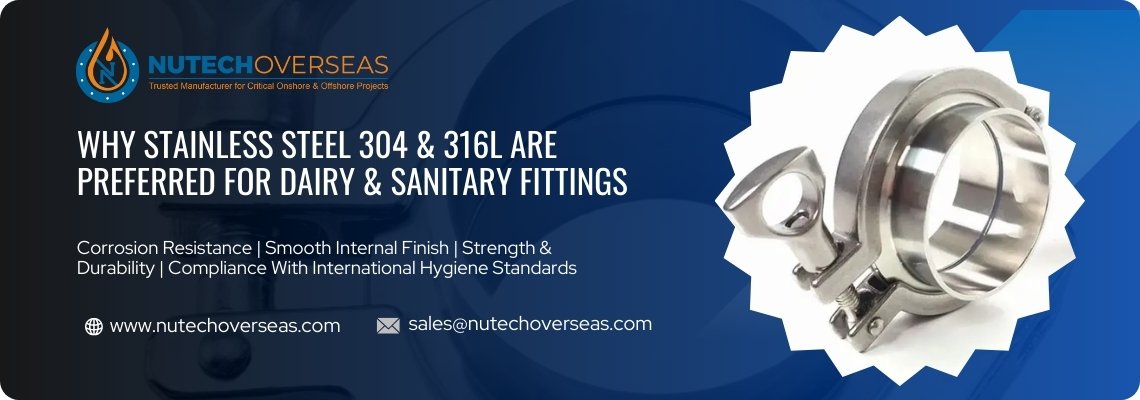
Importance of Stainless Steel in Dairy & Sanitary Fittings
Sanitary fittings are used in systems that handle milk, juices, beer, medicines, and drinking water. The fittings must ensure:
- Corrosion resistance against liquids and cleaning chemicals.
- Smooth internal finish to avoid bacterial growth.
- Strength & durability for long-term use.
- Compliance with international hygiene standards.
This is why stainless steel is the universal choice—and among its grades, 304 and 316L lead the way.
Stainless Steel 304 – The Standard Choice
Stainless Steel 304 (SS 304) is the most widely used grade for dairy and sanitary fittings.
Key Features of SS 304:
- Contains 18% Chromium & 8% Nickel (also known as 18/8 steel).
- Excellent oxidation and corrosion resistance.
- Affordable compared to other stainless steels.
- Highly suitable for general dairy, brewery, and food applications.
Applications: Milk processing plants, brewery pipelines, beverage bottling, and general food-grade piping.
Stainless Steel 316L – The Premium Grade
Stainless Steel 316L is a low-carbon version of 316, with 2–3% molybdenum, making it superior in certain environments.
Key Features of SS 316L:
- Enhanced resistance to chlorides & acidic environments.
- Low carbon ensures better weldability with less carbide precipitation.
- Superior durability in pharmaceutical, biotech, and marine-grade applications.
- Maintains hygienic polish (Ra ≤ 0.4 µm) for sanitary fittings.
Applications: Pharmaceutical industries, biotech reactors, water treatment plants, juice & beverage pipelines, and highly corrosive environments.
304 vs 316L Stainless Steel – Which One to Choose?
| Property | SS 304 | SS 316L |
|---|---|---|
| Composition | ~18% Cr, ~8% Ni | ~16% Cr, ~10% Ni, 2–3% Mo (Low C) |
| Corrosion Resistance | Good | Excellent (better vs. chlorides & acids) |
| Cost | More economical | Slightly higher |
| Weldability | Good | Excellent (low carbon minimizes carbide precipitation) |
| Typical Industries | Dairy, brewery, food processing | Pharma, biotech, corrosive/Marine environments |
Why Nutech Overseas for Stainless Steel Dairy & TC Fittings?
- ISO-certified manufacturer & exporter.
- Wide range: Tri-Clamp Fittings, Dairy Bends, TC Clamps, Ferrules, SMS & DIN Unions.
- Materials: SS 304, SS 316, SS 316L, Duplex & Super Duplex UNS S32205 / S32750, Nickel Alloys.
- Customized solutions with precise dimensions & surface finish.
- Global exports to food, dairy, and pharma companies worldwide.
Final Thoughts
Both Stainless Steel 304 and 316L play a crucial role in maintaining hygiene, safety, and durability in dairy and sanitary fittings. While SS 304 is the cost-effective workhorse, SS 316L is the premium choice for industries requiring higher corrosion resistance.
As a leading Stainless Steel Dairy & Tri-Clamp Fittings Manufacturer in India, Nutech Overseas ensures compliance with global sanitary standards, offering high-quality fittings for food, dairy, beverage, and pharmaceutical industries.
For inquiries, reach out to sales@nutechoverseas.com